17 December 2020

There are times living in a number of different worlds is far from comfortable.

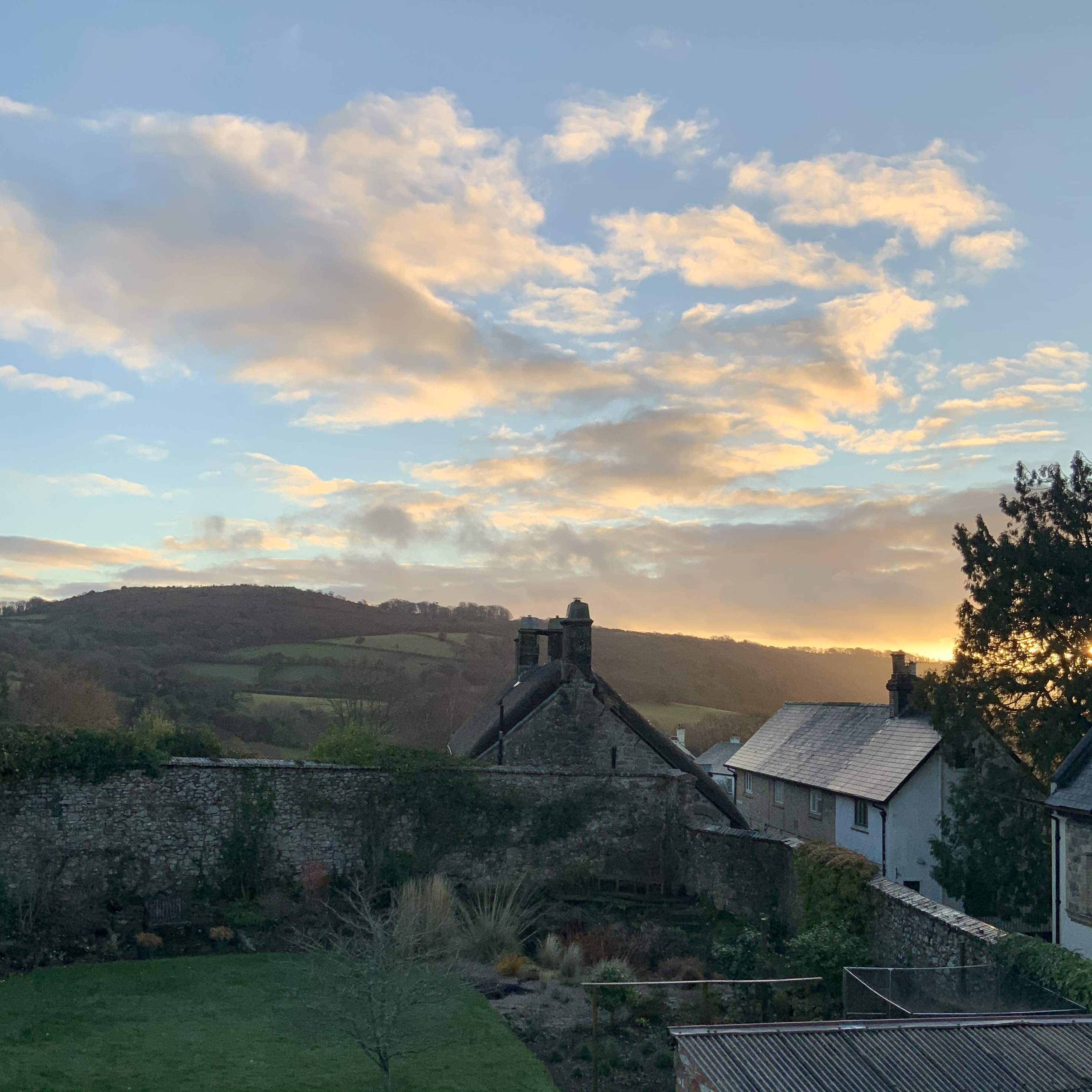
There is the world out there – the real world. This morning’s photograph is a good illustration of quite how beautiful it is in this part of Devon, and last night, late, I lay in an entirely silent house listening to owls call across the valley; then there is the world of work – even now this remains pretty well all consuming. I have just spent the first part of the morning drafting a note for trustees on a salary increase for the Chief Executive; there is my interior life (not necessarily for this blog); and lastly there is the political world that shapes so very much of our lives.

I cannot control the first but that doesn’t matter. Certainly I whinge about the Devon weather but in this part of the world weather comes over like an express train, so it is mainly all down to clothing. I have some control over the world of work, as I choose when and what (unlike so much of my working life as a lawyer) – and if I want to watch a film on Curzon in the afternoon, no one stops me. But the political world is the one that not only can I not control but much of the time at the moment it fills me with despair. The pandemic, Brexit, social care, Windrush, Grenfell – the list seems endless.

There are some actions I have taken. I gave up on Twitter in the early summer, I try to limit my news intake (not always successfully), and I listen to a lot more music. My latest crush is Sara Correia’s 2020 album of Fado.

And then there is condensed reading – possibly not quite the right description but each morning starts with John Naughton, Jonty Bloom, and The Monocle Minute. Jonty Bloom’s Why “Sovereignty” matters this morning is a short and perfect piece. I found Jonty Bloom thanks to John Naughton and Memex 1.1 – from him each morning a Photo, Quote of the Day, a musical alternative to the morning’s radio news, a Long read, and more. Here is John Naughton today. And then there is The Monocle Minute – although I am not into Japanese present wrapping . . .

Finally there is always coffee – probably more than is good for me but not even I can drink Negronis before 6:00.

And my music choice – Sara Correia and António Zambujo

Nos miseri homines . . .

It was pure chance that the weekend before last I happened on the 2017 Christ Church Annual Report. A few days later came the most welcome news of Martyn Percy’s reinstatement as Dean.

In its report on his reinstatement, the Church Times noted,

The row exposed tensions that exist at Christ Church between the cathedral and the academic establishment.

It was ever thus – although there is undoubtedly much more to this than ‘tensions’.

Rows at Christ Church (though rarely quite as public as this most recent one) have invariably been about reform. There have been few periods in its history when reform, of one sort or another, has not been the subject of bitter debate.

Reflecting on this, I re-read Martyn Percy’s piece in the 2017 Report. He begins with the 150th anniversary of the formation of Christ Church’s Governing Body, which recognised its unique status as both college and cathedral. His message is reform. He pulls no punches.

The challenge remains constant: to continue to be shaped by the past, to adapt to the present, and so shape the future.

He continues,

The story of Christ Church is current and unfolding. The changes in governance we celebrated are a timely reminder to us: that within our institutional DNA, we recognise we are a body that knows how to self-improve. Reform is not an event.It is a process. It is more like steady evolution than a one-off revolution. Yet it is a labour that requires constant attention. It also requires some degree of faith – in the past, the wisdom of the body in the present, and the teleology of the foundation as it faces forward.

The dust hasn’t yet settled on this latest row. It will, because it always does. And the battle for reform will continue, as it must. And there will casualties, as there always are.

Martyn Percy’s tweet last Sunday evening – in which he spoke of being marked by the words of the opening hymn at Blackbird Leys Church of the Holy Family earlier that day – speak both of the personal costs of this struggle, and the continuing challenge.

Lord of all our past traditions, Lord of all our future days.

But for the time being – and I hope for some considerable time more – we have our Dean back.

What planet are they on?

There are times when it seems that the City’s great and good inhabit a parallel universe.

This thought been prompted by an article, Bank of England bosses claim Charlotte Hogg’s resignation was ‘disproportionate’, in the Business section of this morning’s Telegraph, and, in particular, that

the outcome seemed to court members entirely disproportionate to the original offence,” said the directors of the Bank in a note recording topics discussed in a teleconference which took place on March 14, the day she resigned.

Any private sector boss making the same mistakes would not have had to quit, the board said.

To which one might respond, #Headinhands, “Up to a point Lord Copper.”

Most observers were surprised that Hogg took so long to resign.

There is no doubt that the Bank regretted her resignation. But ‘disproportionate’? Surely not.

A more considered view was that of the Treasury select committee, whose unanimous report concluded that Hogg’s “professional competence falls short of the very high standards required to fulfil the additional responsibilities of deputy governor for markets and banking” and whose chair Andrew Tyrie offered a much more considered view than it appears the Court held,

This is a regrettable business with no winners. Ms Hogg has acted in the best interest of the institution for which she has been working. This is welcome.


One way to pass an afternoon

In last Saturday’s FT, Christopher Caldwell, a Senior editor at the Weekly Standard, asks what cultural impact will Donald Trump have on America? The Trump Aesthetic is a good article (paywalled), even if somewhat depressing. But why should we be surprised?

I was struck by one sentence,

New presidencies have a ferocious cultural knock-on effect. They change how Washington talks, how provincial America sees itself, and what image the word “America” conjures up abroad.

It’s that last bit I have been thinking about. What image will we see?

Trump may hope it will be the Trump International Hotel in Washington, which Caldwell describes in the opening paragraph of his article.

I have a rather more dystopian image in mind – the Bates Motel.

And one correction.

In the article, Caldwell refers to Meryl Streep’s speech at the Golden Globes, in which, he says, she “deplored Trump’s alleged mockery of a New York Times reported with a withered hand, an accusation Trump denies.” And he points out that the problem with Streep’s comment, “Disrespect invites disrespect’, is that “this is precisely the criticism Trump’s supporters have always levelled at the elites for whom Streep speaks.”

I think Caldwell misses the point. The reporter, Serge Kovaleski, has arthrogryposis, a congenital condition that affects joint movement. Streep talked about Trump (not named in the speech) imitating the reporter (others used the word ‘mocked’) and what Streep was getting at was that by doing what he did, Trump legitimised bullying.

Watch ABC News’ report and draw your own conclusions.

Trumped

Am I enjoying the furore over the Trump dossier? Yes and no. It is extremely depressing seeing Trump live up (or is it down?) to his reputation, and yet at the same time such schadenfreude rarely happens.

But what I am impressed by is the skill of the Russians.

My take – and it is simply that – is that at very little cost they have managed to drive a considerable wedge between a US President and his intelligence agencies, even before he has been inaugurated.

Knowing Trump’s character and how he would react, all that was needed was to provide information through sources trusted by those intelligence agencies, and allow us to do the rest. In time we will learn that most of the dossier is false, but in among its lurid (and as yet unspecified) details there is likely to be sufficient truth to make everyone wonder what is and what isn’t true (and there is also a delicious irony in Trump being skewered by facts that aren’t but which might be). And those truths will have been enough to ensure that Western intelligence agencies couldn’t ignore the dossier.

The UK’s former Moscow ambassador, Sir Andrew Wood,  told the Guardian today that “the report’s key allegation – that Trump and Russia’s leadership were communicating via secret back channels during the presidential campaign – was eminently plausible.” But does that really matter?

For what the dossier has done is to destabilise the relationship between a US administration and its spooks. That is what should worry us.