Mid afternoon yesterday on Mardon Down. Hoar frost not snow.

P.S. [some 24 hours later]: not hoar frost, but rime (or so my weather adviser has informed me).
Enough said: George Wilkinson's blog
"Sometimes I sits and thinks, and then again I just sits"
Mid afternoon yesterday on Mardon Down. Hoar frost not snow.
P.S. [some 24 hours later]: not hoar frost, but rime (or so my weather adviser has informed me).

Recently asked about my favourite day, my answer was either a May morning on the RSPB’s Ynys-Hir reserve in North Wales, or else winter midday on the northern moor. The latter is not a day for birding, but often bright and cold: an opportunity for long views and with the ground frozen less chance of wet feet. The picture that heads all these Dartmoor Letters posts is of the Belstone Ridge one New Year’s Day.
But as most of its visitors have found, Dartmoor weather is unpredictable. This is part of its charm, if that is the right word; and with the right clothing, and a map and compass, the weather is part and parcel of the experience. This is not to say that it doesn’t present its own challenges. We left the house two Sundays ago in sun, but looking towards the top of Cosdon as we drove north, all we could see was low cloud. Okehampton was gloomy, and by the time were at the camp, it was grey and spitting with rain. We walked away, up the military road towards Yes Tor, and as we climbed we entered the cloud. On the top visibility was down to little more than 50 metres as we turned south, first for High Willhays and then Dinger Tor.
Walking and birdwatching do not really go together, but at High Willhays a solitary Raven slowly lifted off the tor into the cloud no more than 20 metres ahead of us, lost in nothingness almost before we had had time to see him; and ten minutes later we heard first, and then saw, a small flock (about 20) Golden Plover.
The track down to Dinger from High Willhays is well trodden and usually easy to follow, but with no real visibility, and the ground spongy and waterlogged, we strayed off course. Stopping, retracing our steps and taking more care than often, we eventually reached Dinger with a certain measure of relief. To the right of the track, running down into the West Okement, the ground is always boggy and finding yourself in that, with poor light and a short day would have been little fun. At Dinger there was a small group of Royal Engineers, most wrapped up and sleeping in bivvy bags, with a solitary, wet and miserable looking picket, cradling a light machine gun. He told us they had been out on exercise for two days and had another five to go: he didn’t look happy.
From Dinger we walked the easy route back, with the weather worsening.
It has been a wet and dreary August. There have been the occasional days of sun, and with it warmth, but otherwise rain and damp, muggy days. Bank Holiday Monday was promised fine and our plan was to walk the ridge west of Great Mis Tor, starting at the car park past Merrivale Quarry and climbing up to Middle and Great Staple Tors before round to Cocks Hill via Roos Tor and Petertavy Common. We should have known better, after a decade living on the edge of the Dartmoor, that the best laid plans …
At Merrivale visibility in the low cloud was little more than 50 yards, and although the route planned is easy, navigation in low cloud across a landscape with few distinguishing features is a challenge. We turned in the car park and drove back to Princetown, parked behind the High Moor Centre and walked out along the disused railway track to King’s Tor. Considerably tamer but just being out and walking was enough.
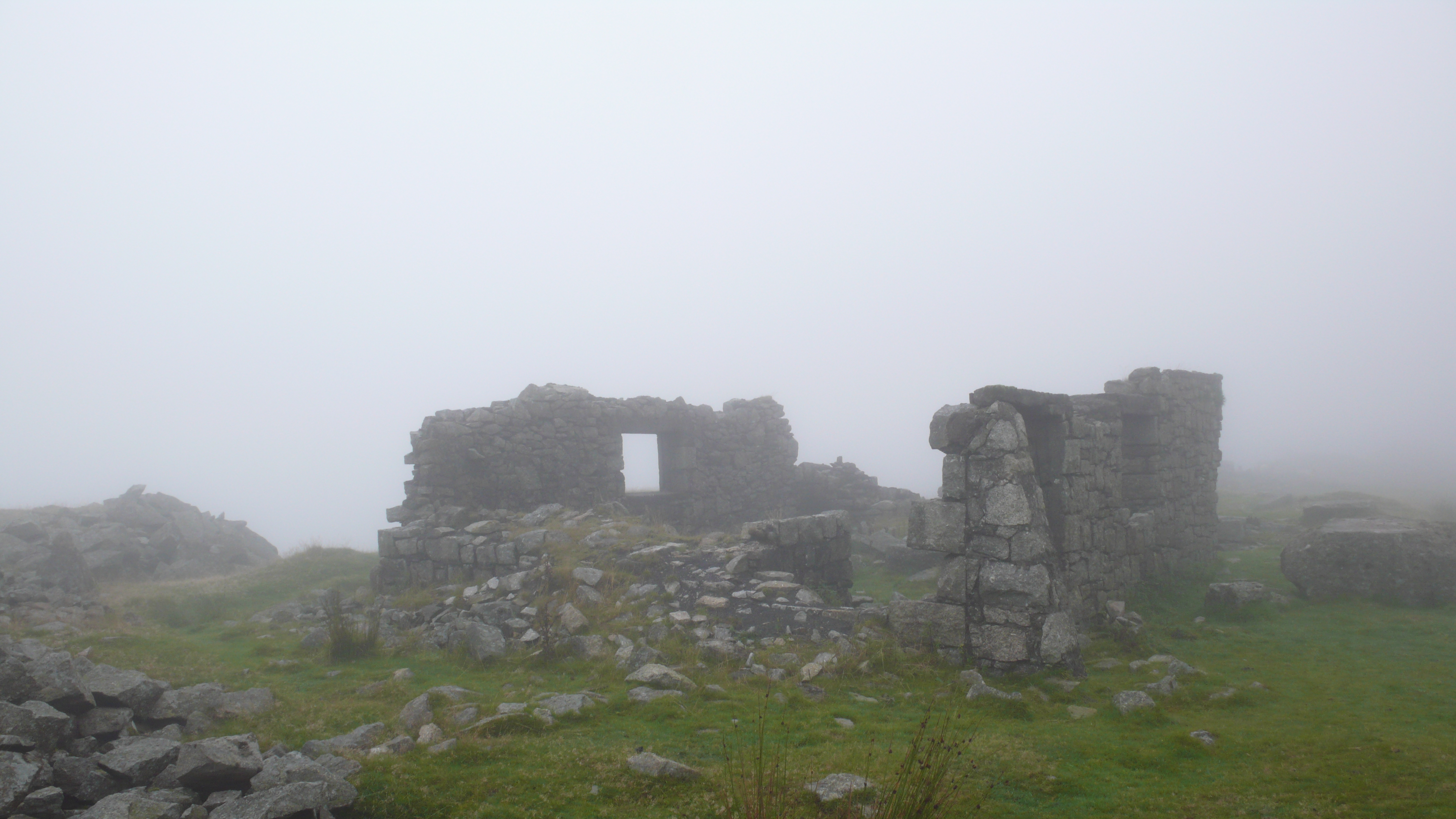
We stopped on the way back to climb up the lip of Swelltor Quarries and were rewarded with the sight of a Raven. Its granite quarries are one of the best places to find Ravens on Dartmoor, and the sight of one below us in the mist was quite magical. The low cloud may have restricted the view, but we found ourselves much closer to those birds we came across than we might otherwise have done. In particular we got within feet of a male Wheatear, which held its ground, looking at us, before flicking away, its white rump the last thing we could see as the mist swallowed it up. For me this bird is summer on Dartmoor, perhaps not surprisingly, as Dartmoor holds the largest population of Wheatears in southern Britain. By the time we got back to the Princetown car park the sun was out, and we drove home under a clear sky.
In a recent Slow Lane column for the FT, Harry Eyres wrote about the rightness of summer; and of summer as kairological time. You need to read the whole column, but in short he contrasted our expectation of summer, that ‘everything will be right, the sun will shine, the company will gel’ with the ‘bitter disappointment some of us feel when summer fails to materialise’. But, he goes on, ‘the essence of kairological time is that it cannot be programmed; those moments of rightness come from nowhere’. And such was last Monday.
Gatekeeper butterflies in the blackberry bushes along the road edge, and Housemartins low across the fields, skimming just above grass height hunting for insects: for all the signs of summer it was, nonetheless, a cheerless start to August.
And yet, between showers, we walked our patch that first weekend: Mardon Down on the Saturday, and Sunday in and around the woods that border the Hennock reservoirs. There is always something to see and hear. On Mardon Down, Yellowhammers: first their unmistakeable song, and then we caught sight of three or four, heads as if dipped in sunshine yellow paint; and Redstarts, a first for us on Mardon. Sunday had us dodging showers. Looking back from the high road to the reservoirs, Fernworthy was half hidden in rain and the edges of the High Moor blurred by low cloud. We walked with the threat of a soaking but were back at the Land Rover before the skies opened, rewarded with seeing that the Great Crested Grebes that we had seen courting in late Spring had had at least one brood. There, at the dam end on Trenchford, the Great Crested Grebe parents and three youngsters, plus a slightly older one.
Today has been one of those April days when we have seen snow, hail, and sun, where a cold wind has kept us out of the garden, and yet the greenhouse has been so warm that I have been in shirtsleeves. We woke to snow, forecast by the Met Office, and as we drove up the hill behind the town, looking back we could see the tops of the High Moor lightly covered. Two hours later we returned in bright sunshine, the back of the Land Rover packed with plants and potting compost.
Spring is in the garden, and despite the fact that we now have help, there is a lot for us to do. Yesterday the roses in the courtyard had to be tied back, and wires replaced; today more tidying up, as well as the new plants to be sorted, and everything prepared. My greenhouse is still waiting for the first alpines.

And this is the time of year when we are pulled two ways, out into a garden that is just breaking into life, or up onto the moor or through the woods, to watch for birds and wait for summer visitors. Last week we were back in Yarner Wood, and knew that spring was here, as we watched Brimstone butterflies along the woodland paths, sulphur yellow males and the lighter greenish tinged females, like autumn leaves but falling upwards. The feeders at the hide were empty, but long-tailed tits romped through the tree tops and we watched a pair of nuthatches cleaning out nest box number 5, below the hide, ready for use. Opposite, in the high pines, we could see, and hear, the ravens. Next time we go, the pied fly-catchers should be back, and the greater spotted woodpeckers nesting.


