Not quite Churchill

President Trump’s recent slur, that Keir Starmer is no Winston Churchill, struck me as singularly ill-judged. The context was Starmer’s refusal to allow the United States to use British bases for the initial strikes on Iran. A war of more than questionable legality, a war with no clear endpoint, and a war into which the President of the United States apparently expected Britain to be dragooned by the invocation of a name.

Not unexpected but wrong-headed.

It sent me to a lecture I had not previously read: Sir Martin Gilbert’s Churchill and Bombing Policy, delivered at the Churchill Centre in Washington in October 2005. Gilbert, as Churchill’s authorised biographer, was not someone disposed to diminish his subject. And what the lecture reveals is a man of such profound moral and strategic contradictions that to deploy his name as a simple taunt for military restraint tells you either that the person doing the deploying has never seriously engaged with Churchill’s actual record, or that they simply don’t care.

Both possibilities are, in their different ways, alarming even if not surprising.

There is a Churchill in Gilbert’s lecture who would have pleased Mr Trump no end. In July 1940 – with France fallen, America neutral, and invasion seemingly imminent – Churchill wrote to Lord Beaverbrook that the only path to victory lay in ‘an absolutely devastating, exterminating attack by very heavy bombers from this country upon the Nazi homeland.’ Bomber Harris later told Gilbert that it was the origin of the idea of bombing the enemy out of the war: ‘It originated with Winston.’ In Moscow in 1942, Churchill told Stalin that Britain ‘sought no mercy and would show no mercy’ and that if necessary they ‘hoped to shatter almost every dwelling in almost every German city.’ These are not the words of a man plagued by restraint.

But there is another Churchill in the same pages.

At Chequers in June 1943, after watching an RAF film of the bombing of Wuppertal, Churchill turned to the Australian representative Richard Casey and asked: ‘Are we beasts? Are we taking this too far?’ Before the Normandy landings, when Portal advised that between 20,000 and 40,000 French civilians might be killed in railway bombing, Churchill told his colleagues he ‘felt some doubts as to the wisdom of this policy’ and wrote to Portal: ‘You are piling up an awful load of hatred.’ He asked Eisenhower to cap civilian deaths per raid at around a hundred. Eisenhower declined. He put the matter to Roosevelt. Roosevelt declined too. And so the bombing went ahead – but it was Churchill who had tried to stop it going further.

After Dresden, Churchill minuted that ‘the question of bombing of German cities simply for the sake of increasing the terror, though under other pretexts, should be reviewed.’ ‘The destruction of Dresden,’ he wrote, ‘remains a serious query against the conduct of Allied bombing.’

And in his final retirement, asked to look back on a life of extraordinary consequence, Churchill said that his only regret was that ‘mankind ever learned to fly.’

Gilbert closes his lecture with four quiet words: ‘It would seem that the “beasts” had prevailed.’

What are we to make of a man who could write ‘exterminating attack’ to Beaverbrook and ‘are we beasts?’ to Casey? Who boasted to Stalin of shattering German cities and then tried to limit French civilian casualties to a hundred per raid? The honest answer is that he was a figure of genuine moral complexity, caught in a war of genuine existential stakes, wrestling, not always successfully, with what total war required of those who prosecuted it. He does not reduce to a symbol of uncomplicated martial courage. He never did.

Which brings us back to Mr Trump’s taunt.

Starmer declined to commit British bases to initial strikes in a conflict whose legal basis is contested, whose strategic endgame is opaque, and whose regional consequences are unpredictable. For this he was told he was no Churchill. But then, Churchill himself – the man who wrote ‘exterminating attack’ and who also asked ‘are we beasts?’ – spent considerable energy trying to restrain bombing he considered disproportionate, unjustified, or counterproductive. He was overruled, more than once, by Americans.

There is something almost poetically appropriate in that.

The question isn’t whether Starmer resembles Churchill. The question is whether anyone invoking Churchill as a standard of unthinking bellicosity has bothered to read about him.

It would appear not.
Crime and punishment

In a piece in the Guardian yesterday, Vernon Bogdanor reflected on how history may judge Johnson’s period in office, recalling Churchill’s remark that “history would be kind to him since he would be writing it”, and suggesting that

Johnson, an admirer of Churchill, may feel the same, and will no doubt seek to polish his record. He should be allowed to do so, free of the vindictiveness and self-righteousness which so often disfigures the liberal left. Loss of the premiership is punishment enough.

There are three problems with this.

The first is that however much you polish a turd, it is still a turd.

Second, it will never be a case of ‘allowing’ Johnson to polish his record. He’s never felt that he has needed anyone’s permission for anything. And so he is already hard at work. You only had to listen to his farewell speech this morning.

And last, why should loss of the premiership be punishment enough? Johnson is a conman – entitled, slippery with truth and facts, a rule breaker, and above all indulged: by his family, his friends, his party, the media, the public. As Bogdanor notes, the central weakness of his administration was Johnson’s belief that “rules are for others, not for him.”

The failure effectively to call him out has got us to where we are – we should not be precious about holding him to account.

A Prime Minister in search of a hero

Although statues are quite rightly very much in the news at the moment, this post is not about them. Instead, read the compelling pieces by David Olusoga in The Guardian last Monday – The toppling of Edward Colston’s statue is not an attack on history. It is history – and Simon Schama in today’s FT – History is better served by putting the Men in Stone in museums.

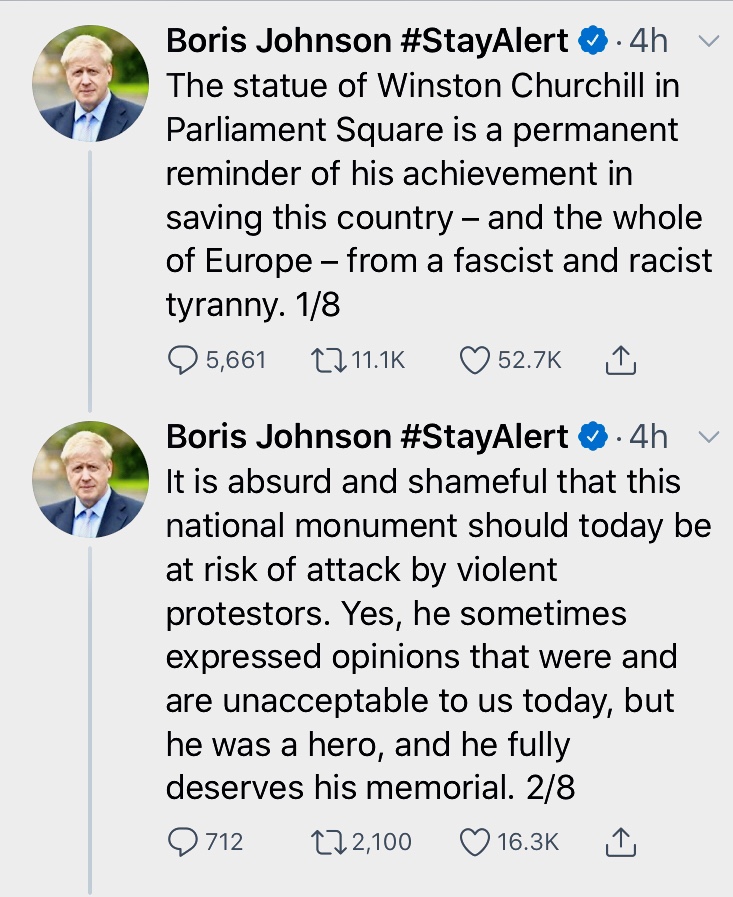
Instead, I want to look at the thread that Boris Johnson posted on Twitter earlier today, and in particular the first two tweets.

In the thread he argues that we cannot now try to edit or censor our past, he deplores the risk of damage to the statue of Winston Churchill in Parliament Square, and, having at least in his own mind placed himself on the right side of history, goes on to claim that the recent protests have been hijacked by extremists intent on violence.

It is all very much aimed at his base (and perhaps not surprisingly it has attracted a considerable number of likes and retweets).

And it is all remarkably disingenuous.

There is certainly a lot going on in the thread as a whole but what about those first two tweets?

As I read them my immediate thought was just how much Johnson wants us to see him as our latter-day Churchill – the hero leader, saving this country from . . .

Well, from what?

It was going to be the tyranny of those ungrateful Europeans. Wasn’t that what Brexit was all about? But it is now, like it or not, the Covid-19 pandemic.

And heroes, Johnson implies, should be forgiven their failings – for no better reason it seems than they are heroes.

Johnson firmly places Churchill against racism (and in doing so he very definitely edits history) and he allows him those unacceptable opinions. And in so doing, Johnson seems to be suggesting that we too should allow Johnson his unacceptable opinions.

Hmmm. He may be disappointed.

Cometh the hour . . .

Whether or not they are thinking it yet (and my money is on the grown ups in the room doing just that), are some in the Conservative Party wondering just how much longer they can leave Boris Johnson in post? May is a long way off.

The analogy with Britain at war in 1940 has been done to death – if I am allowed to use that expression. There is a constant evocation of the Blitz spirit, a harking back to Britain standing alone (not that far off the truth given that we appear to be taking a somewhat different approach to managing CV-19 than anyone else), and appeals to a sense of country and adversity framed in terms of duty and patriotism. And all the while, the Prime Minister channels his inner Churchill, addressing the nation in front of two Union flags, his language a pale imitation of his acknowledged hero.

But just occasionally history has lessons. So back to May, and in particular May 1940. I had a debate with the boss this morning about the suitability or otherwise of Boris Johnson. The argument advanced was that however poor he is, and he undoubtedly is, we should stick with him. I disagree. For all that he tries to emulate his hero, Johnson is no Churchill and is singularly ill-equipped to lead the country through this crisis.

The events of early May 1940 are instructive. Leo Amery lit the blue touch paper in the course of the Norway Debate,

“I will quote certain other words. I do it with great reluctance, because I am speaking of those who are old friends and associates of mine, but they are words which, I think, are applicable to the present situation. This is what Cromwell said the Long Parliament when he thought it was no longer fit to conduct the affairs of the nation: ‘You have sat here too long for any good you have been doing. Depart, I say, and let us have done with you. In the name of God, go.’

speech, House of Commons, 7 May 1940

By 10 May 1940 Neville Chamberlain had gone, the King had called Churchill to the Palace, and there was a National Government in place.

The question now is not whether the Tories can wait until May, but rather whether they should. Now is not the time for party but country – but then we have heard that before.