Not quite Churchill

President Trump’s recent slur, that Keir Starmer is no Winston Churchill, struck me as singularly ill-judged. The context was Starmer’s refusal to allow the United States to use British bases for the initial strikes on Iran. A war of more than questionable legality, a war with no clear endpoint, and a war into which the President of the United States apparently expected Britain to be dragooned by the invocation of a name.

Not unexpected but wrong-headed.

It sent me to a lecture I had not previously read: Sir Martin Gilbert’s Churchill and Bombing Policy, delivered at the Churchill Centre in Washington in October 2005. Gilbert, as Churchill’s authorised biographer, was not someone disposed to diminish his subject. And what the lecture reveals is a man of such profound moral and strategic contradictions that to deploy his name as a simple taunt for military restraint tells you either that the person doing the deploying has never seriously engaged with Churchill’s actual record, or that they simply don’t care.

Both possibilities are, in their different ways, alarming even if not surprising.

There is a Churchill in Gilbert’s lecture who would have pleased Mr Trump no end. In July 1940 – with France fallen, America neutral, and invasion seemingly imminent – Churchill wrote to Lord Beaverbrook that the only path to victory lay in ‘an absolutely devastating, exterminating attack by very heavy bombers from this country upon the Nazi homeland.’ Bomber Harris later told Gilbert that it was the origin of the idea of bombing the enemy out of the war: ‘It originated with Winston.’ In Moscow in 1942, Churchill told Stalin that Britain ‘sought no mercy and would show no mercy’ and that if necessary they ‘hoped to shatter almost every dwelling in almost every German city.’ These are not the words of a man plagued by restraint.

But there is another Churchill in the same pages.

At Chequers in June 1943, after watching an RAF film of the bombing of Wuppertal, Churchill turned to the Australian representative Richard Casey and asked: ‘Are we beasts? Are we taking this too far?’ Before the Normandy landings, when Portal advised that between 20,000 and 40,000 French civilians might be killed in railway bombing, Churchill told his colleagues he ‘felt some doubts as to the wisdom of this policy’ and wrote to Portal: ‘You are piling up an awful load of hatred.’ He asked Eisenhower to cap civilian deaths per raid at around a hundred. Eisenhower declined. He put the matter to Roosevelt. Roosevelt declined too. And so the bombing went ahead – but it was Churchill who had tried to stop it going further.

After Dresden, Churchill minuted that ‘the question of bombing of German cities simply for the sake of increasing the terror, though under other pretexts, should be reviewed.’ ‘The destruction of Dresden,’ he wrote, ‘remains a serious query against the conduct of Allied bombing.’

And in his final retirement, asked to look back on a life of extraordinary consequence, Churchill said that his only regret was that ‘mankind ever learned to fly.’

Gilbert closes his lecture with four quiet words: ‘It would seem that the “beasts” had prevailed.’

What are we to make of a man who could write ‘exterminating attack’ to Beaverbrook and ‘are we beasts?’ to Casey? Who boasted to Stalin of shattering German cities and then tried to limit French civilian casualties to a hundred per raid? The honest answer is that he was a figure of genuine moral complexity, caught in a war of genuine existential stakes, wrestling, not always successfully, with what total war required of those who prosecuted it. He does not reduce to a symbol of uncomplicated martial courage. He never did.

Which brings us back to Mr Trump’s taunt.

Starmer declined to commit British bases to initial strikes in a conflict whose legal basis is contested, whose strategic endgame is opaque, and whose regional consequences are unpredictable. For this he was told he was no Churchill. But then, Churchill himself – the man who wrote ‘exterminating attack’ and who also asked ‘are we beasts?’ – spent considerable energy trying to restrain bombing he considered disproportionate, unjustified, or counterproductive. He was overruled, more than once, by Americans.

There is something almost poetically appropriate in that.

The question isn’t whether Starmer resembles Churchill. The question is whether anyone invoking Churchill as a standard of unthinking bellicosity has bothered to read about him.

It would appear not.
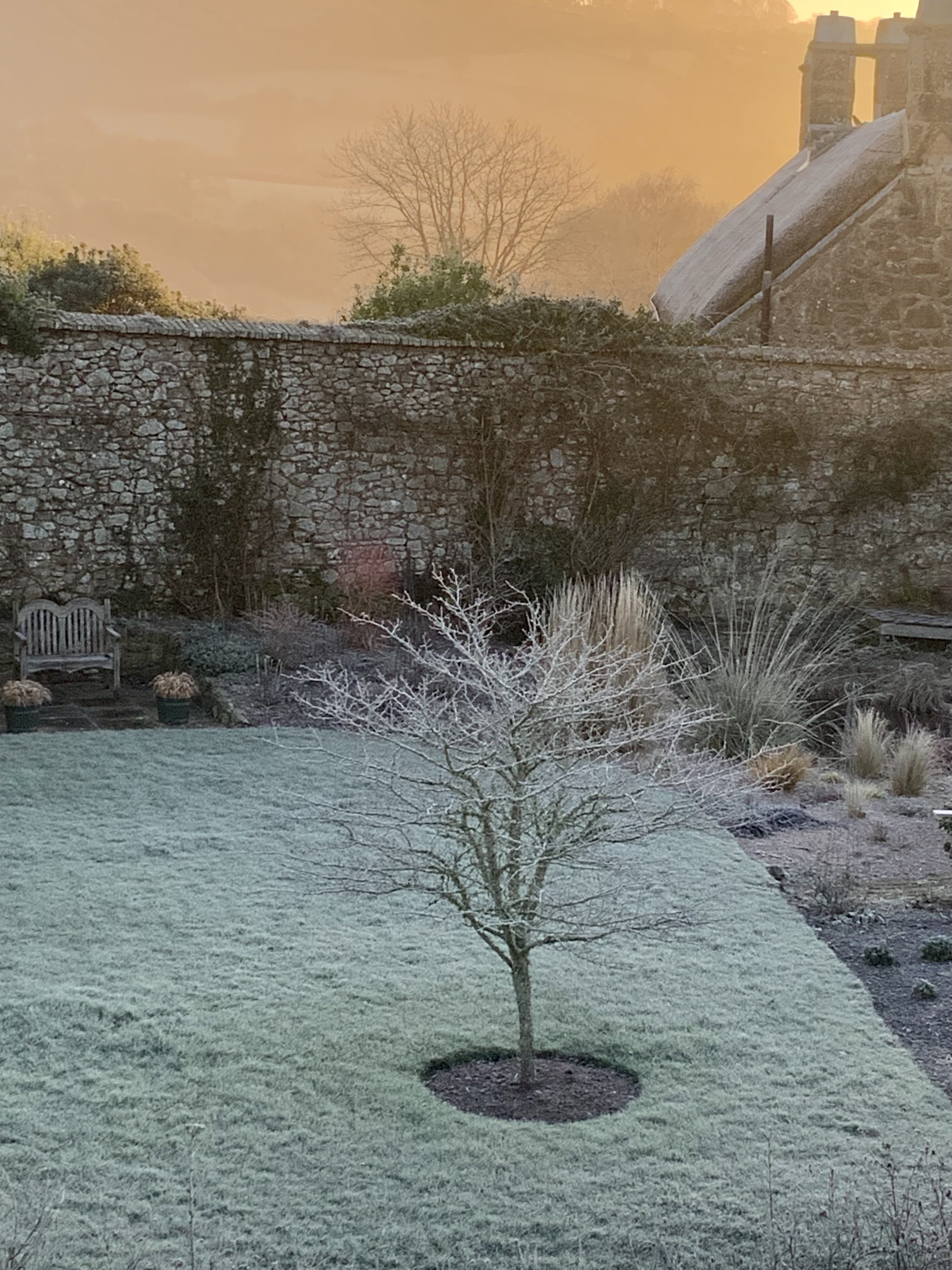
Another cold morning here

It has been a cold morning. Looking out over the garden, in the quiet of a Devon lockdown, it is sometimes hard to reconcile what happens (or doesn’t) here and what is happening elsewhere in the world, whether it is the pandemic threatening to overwhelm the NHS or Trump inciting the mob to threaten the foundations of US democracy.

The last chapter of what Trump has laughingly called “the greatest first term in presidential history” is more like a US Götterdämmerung than anything else. If I was worried about British soft power draining away (see my post A New Year), that is nothing to what is happening to the reputation of the US.

Behind the FT’s paywall but still worth reading Western democracies stunned by images of unrest in Washington.

Trump has always been and remains Putin’s useful idiot. The ‘bigly’ question left unanswered, even now, is why?

It ain’t gonna happen soon . . .

The almost endless stream of news stories and articles about Trump, to say nothing of the streams of tweets from Trump, about Trump, in support of Trump, against Trump, makes for depressing reading but there is an appalling fascination in it all.

And then there are the questions. Why are the Republicans so spineless? What are the so-called Grown-Ups in the White House doing? When will the Democrats get their act together? Will Trump be impeached? Will he jump before he is pushed? What is happening to democracy in the US?

My take on it all is this.

The Republicans are doing nothing – because they are secretly hoping that Trump will blow up (possibly entirely the wrong term) before the Midterms next year, allowing Pence to step into his shoes, steady the Republican ship, and prepare for 2020. Two years is a long time in politics.

The Democrats are doing nothing – partly because they are still looking for a candidate who has a chance of success in 2020, and partly because they would like Trump to remain in the White House for as long as possible, to deny Pence any opportunity to fight 2020 as a sitting President. They also believe that the more egregious Trump’s behaviour is, the more likely that the Republicans will find themselves mired in the failure of his presidency.

The Grown-Ups in the White House are doing nothing – because of who are they are: generals, placemen, and family. The family will stick with Trump as there is no alternative; the placemen will stick with Trump as they owe Trump their position and won’t survive his departure; and the generals are the generals. For them, the habit of following orders is very deeply ingrained.

But the political calculations for both Republicans and Democrats are difficult. If the Republicans leave it too long they may find themselves stuck with Trump as their candidate in 2020, against a candidate who will be a lot harder to beat than Hillary. Equally, if the Democrats do nothing, they may find the Republicans move early, get Pence into the White House, and then they will have to unseat a sitting President.

And as for the Grown-Ups? It is probably already too late for them to do anything. They accepted the ride and the hand cart is gathering pace.

And all we can do is sit and wait and watch the reputation of the US get trashed.

One way to pass an afternoon

In last Saturday’s FT, Christopher Caldwell, a Senior editor at the Weekly Standard, asks what cultural impact will Donald Trump have on America? The Trump Aesthetic is a good article (paywalled), even if somewhat depressing. But why should we be surprised?

I was struck by one sentence,

New presidencies have a ferocious cultural knock-on effect. They change how Washington talks, how provincial America sees itself, and what image the word “America” conjures up abroad.

It’s that last bit I have been thinking about. What image will we see?

Trump may hope it will be the Trump International Hotel in Washington, which Caldwell describes in the opening paragraph of his article.

I have a rather more dystopian image in mind – the Bates Motel.

And one correction.

In the article, Caldwell refers to Meryl Streep’s speech at the Golden Globes, in which, he says, she “deplored Trump’s alleged mockery of a New York Times reported with a withered hand, an accusation Trump denies.” And he points out that the problem with Streep’s comment, “Disrespect invites disrespect’, is that “this is precisely the criticism Trump’s supporters have always levelled at the elites for whom Streep speaks.”

I think Caldwell misses the point. The reporter, Serge Kovaleski, has arthrogryposis, a congenital condition that affects joint movement. Streep talked about Trump (not named in the speech) imitating the reporter (others used the word ‘mocked’) and what Streep was getting at was that by doing what he did, Trump legitimised bullying.

Watch ABC News’ report and draw your own conclusions.

Trumped

Am I enjoying the furore over the Trump dossier? Yes and no. It is extremely depressing seeing Trump live up (or is it down?) to his reputation, and yet at the same time such schadenfreude rarely happens.

But what I am impressed by is the skill of the Russians.

My take – and it is simply that – is that at very little cost they have managed to drive a considerable wedge between a US President and his intelligence agencies, even before he has been inaugurated.

Knowing Trump’s character and how he would react, all that was needed was to provide information through sources trusted by those intelligence agencies, and allow us to do the rest. In time we will learn that most of the dossier is false, but in among its lurid (and as yet unspecified) details there is likely to be sufficient truth to make everyone wonder what is and what isn’t true (and there is also a delicious irony in Trump being skewered by facts that aren’t but which might be). And those truths will have been enough to ensure that Western intelligence agencies couldn’t ignore the dossier.

The UK’s former Moscow ambassador, Sir Andrew Wood,  told the Guardian today that “the report’s key allegation – that Trump and Russia’s leadership were communicating via secret back channels during the presidential campaign – was eminently plausible.” But does that really matter?

For what the dossier has done is to destabilise the relationship between a US administration and its spooks. That is what should worry us.