A bright May morning, clear and warm – the kind of morning that does not concern itself with what happened here.
Philip, my brother-in-law, and I were standing on the rim of the Lochnagar Crater, behind the village of La Boisselle, looking out over gently rolling green fields. Albert, to the south west, was just visible on the skyline. Skylarks overhead, and a whitethroat singing from a bush at the side of the road, quite untroubled.
Philip’s great-grandfather was a private in one of the Tyneside Scottish battalions. Forty years old on 1 July 1916, he and his Battalion advanced behind their pipers across this ground towards La Boisselle, and was killed. The Tyneside Scottish battalions lost most of their officers and men almost immediately. The phrase is in every history of the day. Standing there, I understood for the first time what it means.
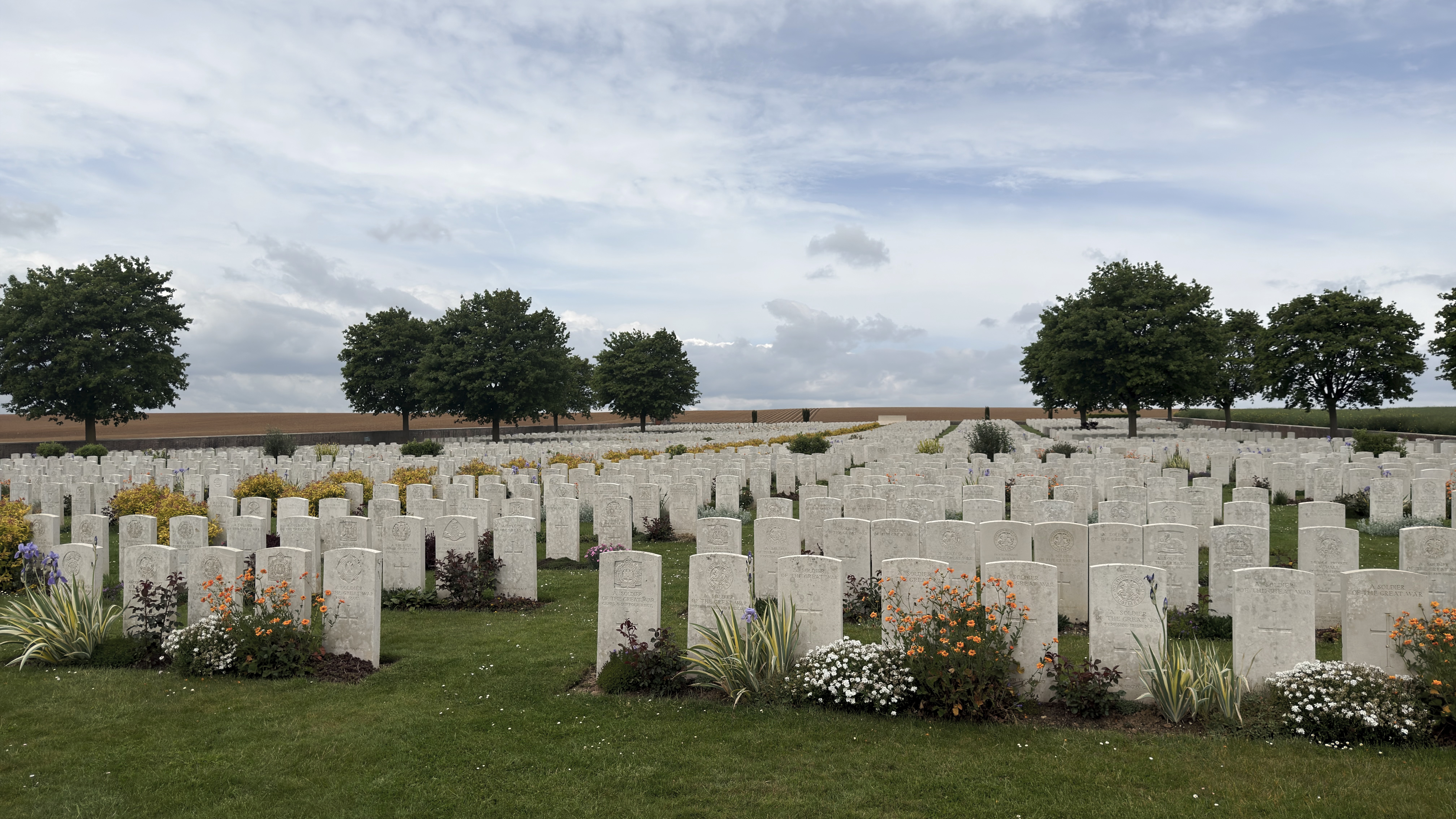
He is buried at Ovillers Military Cemetery, overlooking the village. Philip had stood at the headstone earlier. I had stood with him.
My own grandfather was somewhere behind these lines that same morning. An Edinburgh-qualified surgeon who had joined the 11th Battalion Royal Scots in late 1914 and gone with them to France in early 1915. By July 1916, he was somewhere on the Somme, most likely attached to a Field Ambulance. I don’t know exactly where. History is largely silent on the particular and specific, on where any one man stood at any given hour.
My great-uncle Maurice was killed flying over this same battlefield two months later. He had moved from the infantry to the RFC sometime in the spring of 1916, but his old battalion – the 1/4th Royal Berkshires – were at La Boisselle in mid-July, on the same ground Philip’s great-grandfather had crossed a fortnight earlier. Their War Diary gives some sense of what he would have known, and what the men below him were living through:
La Boiselle was a perfect scene of desolation; the wall of the village was left, the trenches were blown in, all the wire was shot away, and the debris of the battle lying about – dead, equipment, rifles, bombs, kit etc. – the scene was terrible. Our guns had done their work well and the village was completely destroyed. The fortifications of the Germans were wonderful and some idea of the difficulties our attacking troops had to face could be understood.
On 15 September 1916, Maurice and his pilot were reported missing after an offensive patrol over the German lines – a dog-fight with twenty enemy machines.
I have read a great deal about the Great War. I have known people who were in it – my grandfather; my first wife’s grandfather, who lied about his age and enlisted in the Canadian Division and was gassed on the Western Front; others. I thought I understood it.
I didn’t understand it until I stood on the crater rim in the May sunshine, looking out over the killing fields.
We drove from there to the Thiepval Memorial. The names of the missing of the Somme, those with no known grave, are inscribed on the Portland stone panels. Seventy-two thousand of them.
You walk along the panels and your eye travels over the names, and after a while the names stop being names. Then you make yourself slow down, and they become names again. Then something else happens, which I don’t have adequate language for.
The incongruity of it stays with me. A bright morning, green fields, skylarks. A man of forty, advancing.
And all those names.

