
At a dinner earlier in the week, the host (Chairman of a Business Angels Network) and I realised that we were probably the oldest two in a room of 50. It is not that we are that old (mid-50s) but that in the work we do clients and colleagues are getting younger. Law 21, one of the blogs I regularly read, has had a series of interesting posts in the past few days on the issues both of employing Generation Y and having Generation Y as clients. Law 21 is Canadian law blog, but the problems either side of the Atlantic are the same, and there is little difference in the way we approach the issues (or, as is often the case, don’t), and it is certainly not just technology but culture as well. Graduate Divas as lawyers.
Category: Uncategorized
We measure out our lives in 6 minute units
A follow on to my post on The tyranny of time. Today in the FT, Megan Murphy asks whether it is Time to stop the lawyers’ clock, and cites BDO Stoy Hayward’s 2007 survey,
“According to a survey released last year by accountancy firm BDO Stoy Hayward, 97 per cent of company lawyers still use the hourly billing method when paying their external legal advisers. Yet 82 per cent of those surveyed said they believed hourly billing provided “no incentive” for those advisers to work either quickly or efficiently.”
For those of us in the corporate law market, this is not news. What struck me, however, is the fact that Herbert Smith’s expected costs for advising the government of Tajikistan on an alleged corruption dispute
“would represent 2.7 per cent of the central Asian nation’s gross domestic product, where the average monthly wage stands at a paltry $63 (£32).”
I take it that that is GDP before adding back the leakage from corruption.
Chelsea 2008
The RHS Chelsea Flower Show 2008 on BBC2 all this week is unmissable. This year there is a new attraction, Alan Titchmarsh’s quite extraordinary facial topiary. What he was thinking when shaving his sideburns can only be imagined.
Early summer birdwatching
After the heat of the week before last, we have had four days or so of rain. Driving home late Friday afternoon, after two days in the centre of Bristol, the countryside south of Exeter was green and wet, and the roadside verges lost in cow parsley. The early purple orchids have replaced the primroses, and the steep slopes of the Teign Valley are blurred by trees in full leaf.
I am never quite sure when spring ends and summer begins in this part of Devon, but this weekend it feels that we are on the cusp. As I write this post, Caroline is sitting listening to bird calls on the RSBP website (if you haven’t tried it you should), to fix the sounds in her mind. With the start of summer, it is increasingly hard to watch birds in the tree canopy, but you can still hear them. Walking through Yarner Wood a fortnight ago, the pied flycatchers were easy to spot, but tomorrow when we hope to get out again, it will be harder: deeper shadow and thickening leaf cover. This year we are determined to raise our bird watching game, and learn to identify them by song.
Late April we were in Wales, staying outside Brecon and mixing walking and birdwatching, and since then, and much closer to home, we have been in Yarner Wood (pied flycatchers and ravens), by the Hennock reservoirs (blackcaps and great crested grebes) and out on the northern moor (red grouse and ravens).
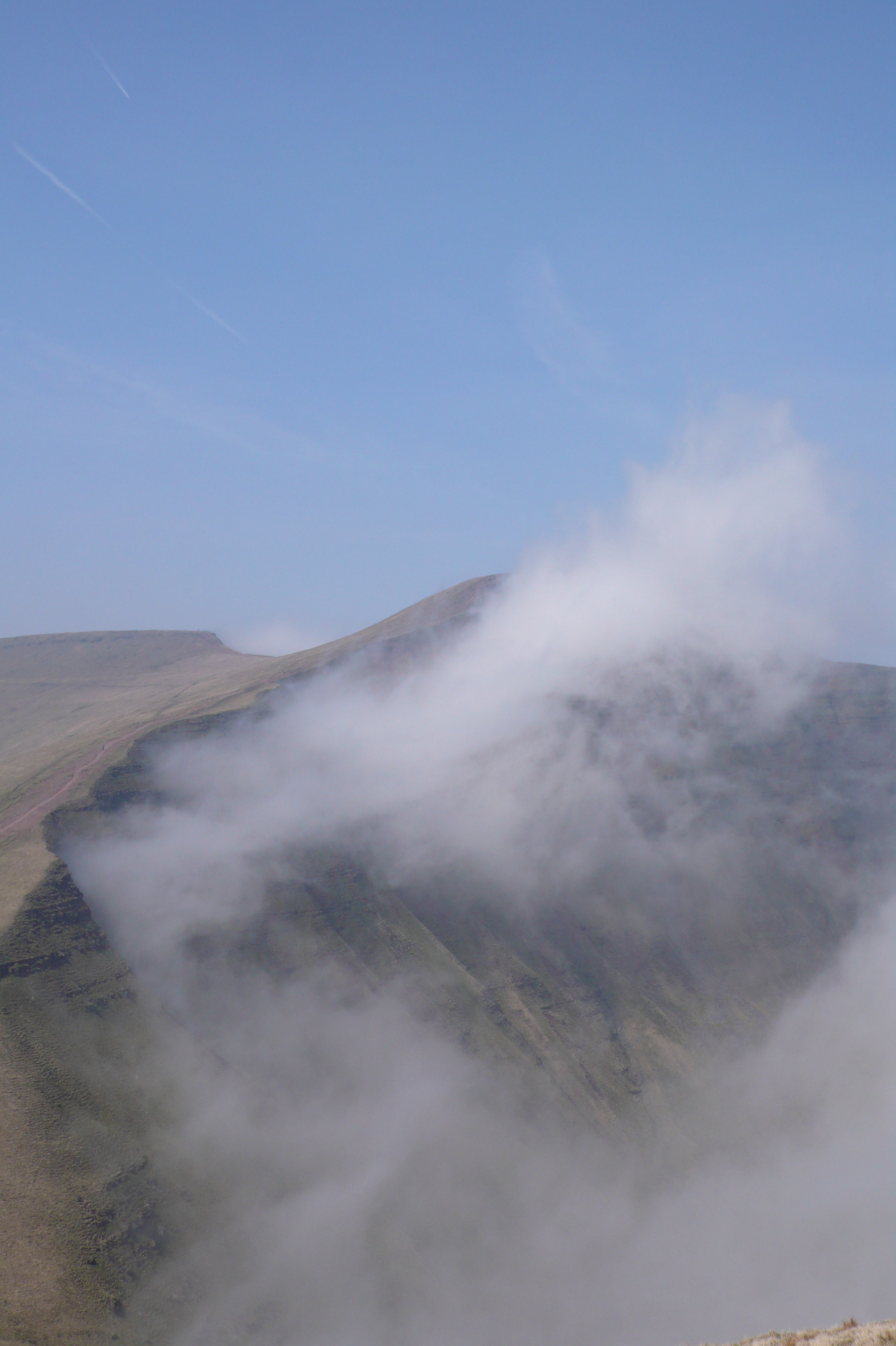
The highlight in Wales was climbing Pen y Fan, highest of the Beacons. We started from the Upper Neuadd Reservoir and climbed easily in hazy sun along the old Roman road.
At the gate at Bwlch ar y Fan, we turned left to Cribyn, the tops lost in low cloud. We heard, before we saw, a group of a dozen or so young men, loud and raucous, first on the path down from Fan y Big, and then coming up fast behind us. By this time they were quieter. Each had a pack, though not a Bergen, so we weren’t sure whether they were squaddies or a college trip.
They passed us easily (the speed of the young) and as they did, their two instructors (we met them on Cribyn, and learnt they were junior leaders) were not even puffing. It was somewhat different for us, but we finally reached the top of Pen y Fan, the final stage up the steep stone pitched path reminding us of Snowdon last year. Sunlight, and ravens in the sky.
We were back in Wales, walking with ravens.
Whither the legal profession?
A stellar panel at the University of Exeter’s symposium last Monday on A Hippocratic Oath for Lawyers: Stephen Sedley, Tony Pinching, Andrew Phillips, Andrew Holroyd (the President of the Law Society), Robin Tolson (leader of the Western Circuit), Kim Economides and an introductory paper by Julius Rocca, putting the proposition in context.
The question was raised in Kim Economides’ letter to the Times,
“Should there not be some kind of Hippocratic Oath for lawyers so that, in future, lawyers’ commitment to justice and the rule of law is more than purely rhetorical?”
An excellent event, academic and professional argument at its best, and a lot to think about; and yet, sadly, very few in the audience (and no truth in the rumour that the minute size of the wine glasses the University uses for entertainment puts people off!). Does the profession care enough? The answer it seems is not enough to want to take part in evenings such as this.

